
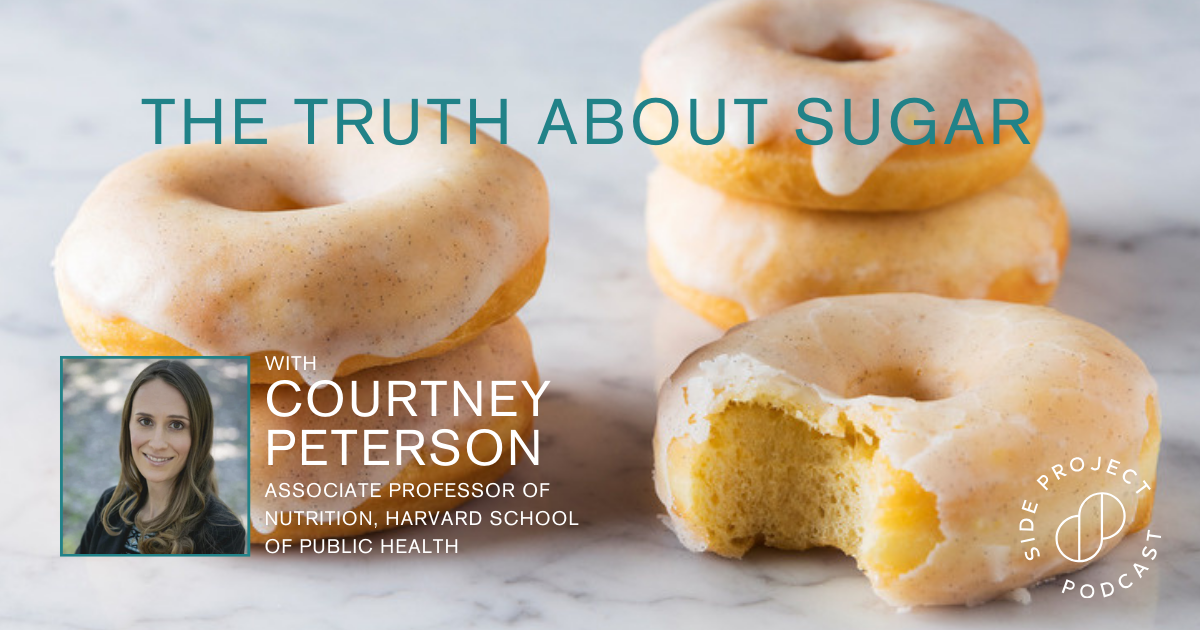
Sugar consumption has grown exponentially over the past two decades, and with it comes much higher rates of things like diabetes and heart disease. In this episode we speak with Dr. Courtney Peterson, Associate Professor of Nutrition at Harvard’s TH Chan School of Public Health, about sugar and cardiometabolic health. Listen in as we discuss how our bodies’ response to sugar changes as we age, how intermittent fasting can help us regulate blood sugar, and how to reduce our consumption of things like sugar, ultra-processed foods, and microplastics.
Side Project Podcast 14: Sugar with Courtney Peterson
Ruthie Miller (00:11.282)
Today, we’re talking about sugar, one of our most requested topics. When I’ve been telling people in the past week we’re doing a session on sugar, they always take one of two paths. Half the people say, yes, I need this. Please help me detox from sugar. And the other half says, but sugar is my best friend. Don’t tell me anything I don’t want to hear.
Julie Liegl (00:52.332)
And I really do feel like, Ruthie, it’s a little bit of a personal attack that you’re having me co-host with you today, because you know sugar is my weak spot. Like I have gummy candy hidden around my home. I know you’re gonna make fun of me 10 times today about how all my vitamins are in gummy form. Sadly, my SSRIs and hormones are not, but I’m optimistic. And I have a See’s Candies on my corner where they know me by name. So I can’t wait to be basically destroyed and have to change my entire life after this. But Ruthie, you’ve had to change your life already. Like you’ve had some big changes when it comes to sugar. Some that started during your pregnancy and then sort of recently some other things that have happened.
Ruthie Miller (01:31.143)
Yeah, I’ve been off the sugar bandwagon for almost 15 years now. I’ve had gestational diabetes three times. I wear a glucose monitor. I am pretty much completely insulin resistant at this point. And I do take metformin to help me stave off the diabetes and pre-diabetes. But it is coming for me. I see that.
And I think about this a lot, like in all the books we used to read growing up, like Little House on the Prairie, when little Laura Ingalls Wilder would have one stick of candy every year for Christmas. And that was like her joy for the whole year. And now there is sugar all over the damn place. I mean, we cannot get away from it.
Julie Liegl (02:23.18)
Yeah, but Pa was really bad at farming. So was that the way it was or was it just that Charles Ingalls was a poor businessman and couldn’t afford sugar?
Ruthie Miller (02:30.536)
And that was always Nellie’s brag is that she had candy anytime she wanted because her parents owned the store.
Julie Liegl (02:36.758)
Well, Nelson and Harriet were tycoons of Walnut Grove. We should do a Little House episode. It is interesting though. I mean, sugar is, it’s so available. It’s so, I mean, I even think when I was a kid and I’d get like a candy bar at Halloween and now it just feels like candy is everywhere and in so many different forms and like my kids sort of expect it. And I know that that’s not a great thing and probably something we need to work on.
Ruthie Miller (03:07.666)
Well today we have with us Dr. Courtney Peterson. Dr. Peterson is an associate professor of nutrition at Harvard’s Chan School of Public Health. She is an internationally recognized expert in intermittent fasting. I always have trouble saying that. In fact, she was the first person ever to test early time restricted eating in humans. She has a seriously impressive resume, including five degrees and Julie and I just discussed that we have five between us. So…
Julie Liegl (03:39.712)
It takes two of us to make one Dr. Courtney Peterson.
Ruthie Miller (03:07.666)
I think we are a little outmatched today. I’ve always thought Julie is the smartest person I know, but now we know Courtney. So Julie you’ve been knocked off that pedestal. Anyway, welcome, Dr. Peterson!
Courtney Peterson (03:54.884)
Yeah, thank you so much for having me. I think this will be a fun conversation today.
Julie Liegl (04:01.558)
Yes. Thank you so much for joining us. Let’s dive right in. One of your main focus areas is cardiometabolic health. What the heck is cardiometabolic health and why is this something we need to think about, you know, overall, but especially as we age.
Courtney Peterson (04:19.619)
Yeah, great question. So in the United States, the leading sort of cause of death is cardiovascular disease, by far. And then diabetes is up there too. And what we’ve sort of learned is, you know, it’s almost half of the American public has hypertension. So massive numbers of people, 11% or 12%, have diabetes. And the really interesting thing that we sort of learned over the last decade is the two diseases are far more interlinked than we ever thought.
And so for instance, there’s some research showing that about 90% of patients with heart disease have what’s called insulin resistance. And insulin resistance is basically a blood sugar problem. It’s this sort of fancy term, but what it basically means is the blood sugar hormone insulin has trouble moving sugar out of your bloodstream and into your cells. So that sugar kind of backs up in your bloodstream and raises your blood sugar levels.
And so what we’ve learned now is these diseases are so intertwined, we need to almost think about them as one in the same disease. And in fact, it’s something like, you know, the vast majority of, I think it’s something about 70% of all cases of diabetes we think are due to a poor diet. And it’s a little bit less, but it’s over half of all cases of cardiovascular disease we now think are due to diet. So it’s not genetics, not exercise, not sleep, right?
And so the common sort of link here is we know a poor diet can cause blood sugar problems. And it seems that blood sugar drives a lot of these different conditions we have in the body. So we now kind of collectively think of these diseases as sort of being sister diseases, they’re going hand in hand with diet being the biggest driving factor. And in fact, there’s such a strong link now that we, just in the past years, the American Heart Association is starting to also link kidney disease in there too, because that poor diet also is linked with kidney disease and cardiovascular disease, and diabetes sort of contributes to kidney disease. So they’ve created this new term, cardiovascular kidney metabolic health. And it’s this concept that we should be thinking about them all as a cluster. So diet and how we metabolize energy and sugar is one of the biggest common pathways linking all these diseases together and driving them.
Ruthie Miller (06:34.952)
So heart, blood sugar, and kidneys all together. That’s what makes cardio metabolic health.
Courtney Peterson (06:38.999)
Yep, correct. And we also will usually lump stroke in there too, because it’s often sort of, you know, it’s a vascular disease. It’s all, it’s related. Yeah.
Ruthie Miller (06:48.86)
It’s a potpourri.
Julie Liegl (06:53.772)
And you said poor diet and I know like the topic today is sugar, but I just want to like call out the fact that like anti-inflammatory, like keto, low fat, like when you say poor diet, you know, as a doctor in this area, what are the key things you mean? Clearly sugar is one of them, but like what are the sort of hallmarks of a good versus a poor diet?
Courtney Peterson (07:18.465)
Yeah, so great question. So one of the things we know is the average American eats about 50 to 70 percent of their foods as ultra processed foods. So those are things that pretty much everyone listening to this podcast would walk into a store and say, yeah, I shouldn’t buy soda or the bag of Doritos or the, you know, the Little Debbie’s mini cakes. So things like that that are really easy for us to recognize is, you know, bad foods. And then additionally, in the field of nutrition research, we also look at things like: Do people have a sufficient number of healthy fats? Do they eat enough whole grains, whole fruit, either meat or another good protein source? And a lot of people are deficient in these healthy food groups as well. So we kind of look at this holistically. It’s not one factor versus the other, but the American Diabetes Association right now says there are multiple healthy diets, which I believe, and I think most researchers believe, there are multiple ways to be healthy.
But unfortunately, there are also multiple ways to be unhealthy and lots of poor food choices in the store. And a lot of it’s driven by convenience. Like a lot of these ultra processed foods, they’re addictive. They also are shelf stable. So meaning they last for a long time on the market. And actually the other sort of more insidious things these days, a lot of them are almost rebranded as healthier-for-you alternatives. So this is a newer trend. They will say all natural ingredients. And I’m like, yeah, but it’s still like a chip or a cake or something that’s going to spike your blood sugar. So all these things are sort of components of a poor diet.
Ruthie Miller (08:56.624)
That’s interesting and terrifying at the same time. So healthy aging has really become kind of a topic de jour lately. And I don’t know if that’s because we pay attention to it more now, since we are in that category, or if it is actually a topic that is coming up more in our society and our culture. But you are part of something new at Harvard, which is the Healthy Aging Initiative. Can you tell us a little bit more about that?
Courtney Peterson (09:24.739)
Yeah, absolutely. So we are in this incredible sort of research environment at the Harvard Chan School of Public Health where we have nine different departments that each kind of tackle a topic related to the aging process. So I’m in the Department of Nutrition. There are other folks, faculty members or researchers in the Department of Molecular Metabolism who are understanding like, how does the body age? How does fasting and feeding cycles or fasting and eating cycles affect the aging process?
We have other faculty members or researchers in the Department of Environmental Health who are trying to figure out, how does air pollution aid you? There’s some really interesting data there showing that air pollution is actually the third cause of death worldwide. And most people don’t know that. It’s really high, especially in the developing world. So for instance, in Delhi and India, life expectancy in the average inhabitant is reduced by about 10 to 15 years. So mean, we’re talking about staggering effects in some places. And then also exposure to microplastics, which has become all the rage in research over the last year. We’re finding microplastics and nanoplastics are associated with higher risks of heart disease, of dementia. So some really sobering statistics. But then there are also social or lifestyle factors – like how many friends do you have? How good are your connections? Do you volunteer? – that contribute to your community on a broader scale. And so all of us kind of are part of a big picture puzzle, like how do we age well and live healthy? And one of the biggest developments of the 20th century is, know, sort of the development of hygiene has been this massive public health success where we’ve reduced the death rates. And so now most people are able to live to a much older age, live into middle age and beyond.
And we think the next frontier now, because so many Americans have obesity, is figuring out, how do we lower the risk of obesity, but also help people age in a healthy way? And there’s so many influencers out there who are sort of peddling supplements or saying, you know, this one drug, metformin or rapamycin, will help you live forever. And we want it to be the voice of reason, which is like, here’s what we actually know about healthy aging. Here’s how you put together a good plan for yourself. And we sort of have this ambitious goal. We want to help people add at least 10 years of life to their lifespan. And what I mean by that is we want them to add 10 healthy years of life. So 10 extra years where they’re free of disease and disability. And so that’s this concept of health span. And so we have sort of two goals. So one is we want to start perhaps a YouTube channel or some way to get this information out to the general public to help people. And the second thing we want to do is obviously more research in this area so we can help more people. So we are trying to establish a new center.
So if anyone is interested in either giving us advice for like, how do you want content? Would you want a newsletter, a YouTube channel? What topics are you most interested in? We’d love to have that information. And then second, if you also want to contribute either financially or in terms of time, please reach out. So we are definitely looking to start that center. Laura Barnes in the Office of Alumni Affairs and Development is helping us with that. And she can be reached at lbarnes@hsph.harvard.edu.
Ruthie Miller (12:46.344)
Perfect, and we are happy to put all that stuff on our website too for anyone who’s interested. And so getting more into that healthy aging conversation, let’s go back to sugar specifically. How I feel like, you know, when we’re young, we can process sugar, or at least in my case, I could process sugar and now I cannot. Is that a common thing? Do our bodies, do they change how we process sugar?
Courtney Peterson (13:13.087)
As we age? Absolutely. So in younger adults, on average, about 10% of younger adults have type 2 diabetes and the rates rise to about a quarter by the time people are of retirement age. And what we know is as people age, two things sort of happen in the body. So one, in your pancreas, your pancreas is sort of the organ in your body that produces insulin. So it becomes less good at producing insulin over time. And we call that insulin secretion, but your pancreas becomes less good at that. And then second, in particular, your muscle cells in your body and your liver become less good at reacting to insulin. And we call that insulin resistance or insulin sensitivity, basically opposite sides of the same coin. And over time, some of that we think is just due to the natural aging process. So there are a bunch of different theories of how we age. They’re all really fascinating. But one of them is sort of this molecular damage theory of aging, which is over time, your body accumulates this molecular damage. And that sort of makes things less efficient in the body and slows effectively slows down your metabolism. But there’s other theories as well. So another theory is like maybe your circadian rhythms aren’t as good as they used to be when you’re younger. Right. So we know as you get older and you hit perimenopause and menopause, a lot of people have sleep problems. And we know from research on sleep that when you don’t sleep well, that raises your blood sugar levels. And then a third factor is what’s really interesting, women have estrogen. So this is a female hormone. And when they’re younger, women have a very slight advantage in processing blood sugar. They’re a little better than men. So on average, I would say by and large on average, they’re not major differences between men and women. But when women are younger, they’re a little bit better than men at processing sugar in their bloodstream. Part of that’s due to estrogen, because estrogen sort of helps with that process. But the other part is due to the way we store fat. So women, we’re lucky. Our bodies tend to prefer to store fat in what are called our subcutaneous fat stores. So this is sort of like the fat that you can pinch on your body. So this is like your thigh fat or your stomach fat that you can really pinch.
Courtney Peterson (15:28.099)
Men are a little unlucky in the sense they tend to store more belly fat. And it’s the deep belly fat that we call visceral fat. And we know that visceral fat, you know, tends to increase blood sugar levels. But the punch line is they have the bad belly fat. So they’re a little bit worse. But come the transition to perimenopause, to full-blown menopause, women lose that advantage. And in fact, there’s some data that suggests that after menopause, they’re actually a little bit worse than men at processing sugar in their bloodstream. And a lot of that’s due to estrogen. Some of it’s also due to the fact that, you know, once you hit menopause, you tend to store more fat in those deep belly fat layers, that’s visceral fat. So we kind of lose our advantage as we get a little bit older.
Julie Liegl (16:18.926)
Yay, us. What I’m hearing is the whole stereotype of stressed out women or PMS-ing 20-somethings eating ice cream and candy, it’s because we had this huge advantage. We were processing our sugar so much more effectively. Our bodies were giving us what we needed.
Ruthie Miller (16:37.8)
That’s funny, I heard women are lucky because we used to have fat in our thighs. And I was wondering where is the luck in that?
Julie Liegl (16:42.732)
Well, I don’t. I carry my weight like a man, but I never realized, like I carry my weight in my belly. And I always thought that meant I had the man disadvantage. But you’re saying since I can pinch mine, it’s not as dangerous as my husband’s belly that it’s not as pinchable.
Courtney Peterson (16:55.893)
Not as bad. Correct. So if you’re more pear shaped, we think of that as better fat to have. Like you’d have the hip fat. And then second, if you don’t have the pear shape, then the next best is that subcutaneous pinchable ab fat and then the deep fat ab fat as well.
Julie Liegl (17:03.936)
I’m not, I’m an apple. I’m Humpty Dumpty on stilts. It’s not great. And I was like, great, it’s not attractive and it’s the less healthy way to be fat, but it’s pinchable, you know.
Courtney Peterson (17:26.017)
And the other thing, Julie, you alluded to, mean, stress is such a big one here. So cortisol is a hormone that your body produces, it’s involved both in stress, it’s also actually part of your circadian rhythm, so it’s a little more complicated. It’s not quite as straightforward as you hear, but in general, higher cortisol levels mean more stress in the body. And we know when cortisol levels are raised, which can be either because you have a lot of stress at work or at home, or even if you just have an infection, that raises your blood sugar levels too. And so I think for a lot of us, some of the aging process is just we have a lot on our plates, right? Dealing with either kids or our parents or both at the same time. And so that’s another really important factor.
Julie Liegl (18:08.974)
Yeah, this is all very sobering. Talk to us about sugar because I think another thing we hear a lot is like, well, there’s different kinds, like, you know, high fructose corn syrup bad, but just use honey or maple syrup or agave. Like, is there really a difference in how our body reacts to these or is it all the same?
Courtney Peterson (18:30.219)
Yeah, absolutely. So there is a difference in how we react to some of these sugars. And I think, you know, just to take the story back, you know, so 15 years when I started in the field of nutrition research, low fat diets were all the rage. And probably most of our listeners could remember that. And why would anyone want to study a high fat diet? Aren’t high fat diets terrible? We need more snack oils. Exactly.
Julie Liegl (18:50.702)
Eat as many snack well cookies as you want and you’ll live forever.
Courtney Peterson (18:55.651)
And if you remember the food pyramid from the nineties, like eat like six to 11 servings of grains. I was like, gosh, there’s so many, I’m gonna have to eat more grains. Fast forward many years and we now realize, you know, not all fats are bad. There are good fats and bad fats. And I think ironically, we have swung to the exact opposite extreme, which I think is also just as wrong, which is we think a lot of people think all carbs are bad. I don’t think that’s true. I think there are good carbs and bad carbs. And so the question is, what are the good carbs and what are the bad carbs? So I think, you so from what we call epidemiologic studies, these are studies where you go and ask people like, what do you do? What we see pretty clearly is in general, whole fruit is good for health, fruit juice is not. And so…
Ruthie Miller (19:44.817)
And what kind of sugars are those though? Is that like glucose, sucrose? Natural sugars?
Courtney Peterson (19:52.002)
Right, they’re natural sugars. there are sucrose and fructose are the most sort of a common or most important sugars that are involved. But they’re also accompanied by a lot of phytochemicals or plant-based nutrients. So we think they’re good and I’ll come back to that in second. But we very clearly, I mean, if you separate out fruit juice and whole fruits, we very clearly see a signal that fruit juice raises your risk of diabetes and whole fruit lowers it. And in fact, there’s even data suggesting that people with type 2 diabetes who eat the most amount of whole fruit have a 90% lower risk of dying, which is massive. So really exciting effects. And then legumes or beans, they’re fantastic. We’ve sort of always known that there’s never been any controversy there. And whole grains sort of consistently are shown as beneficial. Now, I actually think the story with whole grains is more nuanced. So it’s pretty funny because most people who study low carb diets thinks, know, whole grains are the devil and then a lot of researchers who do these epidemiologic studies say, they always come out as good. I think it’s more nuanced. I think some whole grains are good and some are bad. And a really simple way to think about it is when you grind whole grains to kind of a flour or a pasta, or, you know, into sort of a flour form. So I’m talking largely about pastas and breads. We see about the same blood sugar response, whether you’re eating a refined grain or whole grain. And the reason for that is when you grind it to such a fine flour, your digestive system can absorb it really quickly. And so it kind of spikes your blood sugar level.
Ruthie Miller (21:26.92)
And that’s bad, right? You want your body to work harder to digest.
Courtney Peterson (21:31.47)
Correct, we want that sugar to hit your bloodstream more slowly. So we don’t want the spikes in the crash, because what happens is if your blood sugar goes up rapidly, you have to produce a lot of insulin, and then it can come down and crash, and then you’re just starving, and you want to eat more. So we think it both stimulates you to eat more, as well as messes up your blood sugar long term. The interesting thing is if you grind beans to a flour, or if you blend fruit into very fine particles, we don’t see the same exaggerated blood sugar response. And part of that is that beans and fruit are particularly high in compounds called polyphenols. And this is a class of antioxidants. And the really neat thing or the cool thing about polyphenols is they actually slow the rate at which your body absorbs sugar into its bloodstream. And they do that by actually winding to the little receptors that absorb sugar and take it into your body. And so for these types of foods, you get a little bit of a blood sugar spike, but it’s not a big deal. These days, for instance, they’re even flat pastas made of chickpea flour. And we don’t see the big exaggerated blood sugar response like we do with the whole grains turned into pasta or flour.
Ruthie Miller (22:34.383)
Yeah, I was just gonna ask. Like, a regular pasta is the worst, probably. And then whole wheat pasta might be slightly better. And then chickpea pasta and the like might be slightly better than that kind.
Courtney Peterson (22:54.627)
Correct, exactly. And so my best guess is whole grains, like in the form of like a slow cooking oatmeal are good for you. But if it’s an instant oatmeal, or if it’s a pasta or bread, then probably not so good for you in the long run. And so I think the story with whole grains is nuanced, but the data we have on beans, legumes, at least whole fruit is very compelling. These seem to be beneficial foods.
Julie Liegl (23:25.848)
But I’m hearing smoothies. Like, I make my kids a lot of fruit smoothies. Grinding up that fruit is not the equivalent of giving them juice. It’s still getting those benefits of whole fruit.
Courtney Peterson (23:30.403)
Correct. Yes. Plus you have the fiber, and that’s going to feed the good bacteria in your gut. That’s really important. And then the fiber fills you up faster. So just there are all kinds of beneficial effects. And one of the really cool things about the fiber is it feeds the bacteria in a way that they produce something called short chain fatty acids. And those short chain fatty acids, at least in our studies in animals, are then taken up by the brain where they actually slow the rate of cognitive decline.
Julie Liegl (24:19.288)
Short chain fatty acids is actually Ruthie’s and my band name.
Courtney Peterson (24:20.963)
So these are the kind of really cool links that we have between diet and your health, we can show that we, at least in animals, we can show that by eating more fiber, we can actually improve brain health. So these are the kinds of really cool connections out there that we’re learning.
Julie Liegl (24:25.038)
I am curious though, like specifically honey, syrup, sugar. Is my body like, it’s all the same or, because I feel like some people are like, add honey to your, know, to sweeten the thing and then it’ll be healthier. True or not true?
Courtney Peterson (24:41.635)
Yeah, honey is a little bit better, but it’s still probably is not as good for your blood sugar, you know, as eating the whole fruit. There are newer products on the market. So there’s stuff, there’s something called date sugar, which is just powdered whole date. So there are some products that are a little bit better, you know, honey is going to be certainly better than like a powdered sugar you’re going to buy from the store. But at least you shouldn’t be thinking like, oh, this is healthy. I should eat as much as I can.
Julie Liegl (25:08.718)
I’m really, really curious. How do you feel about artificial sweeteners? Because I feel like I read an article once, probably like 15 years ago, that your body starts to react to it the same as sugar. So it’s no good. And I know how you feel about ultra processed, but like, is throwing a Splenda to sweeten something up in much, much better for you or is it all the devil?
Courtney Peterson (25:31.16)
Yeah, we’re still trying to figure this out. And some of the best research I’ve seen suggests that in some people it really badly messes their blood sugar levels. And it seems to do that by affecting the healthy bacteria in their gut. And so some people, if you put them on artificial sweeteners within a week, their blood sugar levels rise. And other people aren’t as responsive. So we don’t know yet who has these negative effects and who doesn’t. But it’s enough for me to say I don’t recommend them. Now, if they’re a crutch to get off soda and that gets you in the right direction, I’m all for it. Like these can be powerful tools, but in the long run, I would absolutely avoid.
Ruthie Miller (26:09.996)
One of your focuses is intermittent fasting. Let’s talk about that for a minute. What’s the science behind intermittent fasting and how does it help us regulate blood sugar?
Julie Liegl (26:22.166)
And is it just skipping breakfast?
Courtney Peterson (26:22.081)
All great questions. So intermittent fasting is a sort of broad term that basically means alternating periods of eating and longer periods of fasting. And I was recently on an international consensus committee of experts and we’re defining intermittent fasting as fasting for at least 14 hours at a time. There are many types of intermittent fasting. And I like to group them into three broad categories. The first approach is where you fast for at least 24 hours at a time on water only. So these are common in a number of religious traditions, to pick one day a week, like a Sunday or Saturday, and to not eat anything and just drink water. Other examples of this would be there’s even an approach called alternate day fasting where every other day you don’t eat.
Not something I would recommend for most of your listers unless you have severe obesity. Seems to be very good if you have severe obesity, not feasible for like most people though. The second type of approach we call kind of modified fasting, and that’s when you eat a very low calorie diet some number of times per week or per month. And by very low calorie diet, we actually have an official definition and it means less than 800 calories a day. And so,
The beauty is, so it’s more extreme approach, but the beauty of these types of approaches is you can still eat some food, but you’re getting a lot of the benefits of fasting. So examples of this, there’s something called the 5:2 diet that’s very popular in Europe, where you pick two days a week to basically eat the equivalent of one meal a day. And another example of this is the fasting mimicking diet, where you pick typically five days in a row to eat a very low calorie diet. And this is an approach that they’re starting to test in cancer patients to see if they can actually help fast the cancer cells to help shrink them during chemotherapy and radiation. And we actually have a clinical trial that we’re working on in this space too that we’re very excited about. And then the third category of approaches, the ones that most people think about when they think of intermittent fasting are your daily intermittent fasting approaches. So this is where you eat in a shorter time period each day, which you can do either by eating breakfast later in the day and or dinner earlier in the day.
And we call these approaches time-restricted eating or TRE. I’m not a huge fan of the name because it’s very jargony, but just think of them as daily intermittent fasting. And so typically we define this as eating in a 10-hour period or less every day, so fasting for at least 14 hours a day. And the really interesting thing is we’re finding, I’d say in the last year it’s become clearer that we’re finding, we’re starting to find like there’s a, I don’t want to say a magic threshold, but there’s a threshold where we really start to see benefits.
And that’s eating in an eight hour period and fasting for at least 16 hours a day, which is also known as the 16:8 diet. So we now have very good data suggesting that doing the 16:8 diet does help people lose weight. And it’s not a small effect. It’s a meaningful effect. So in patients or people who have obesity, they are typically losing about, you know, about an extra half a pound a week. So this is equivalent to cutting your calories by about 200-250 calories a day. So we’re quite excited by these findings.
Julie Liegl (29:40.856)
Can I have coffee if I do 16-8? Is that breaking the fast if I have coffee before my 16 are up?
Courtney Peterson (29:48.974)
Yeah, a little controversial, even among scientists, we don’t all agree. But the one thing we agree on is if you add cream and sugar to your coffee, that’ll break your fast. But if you drink it black, it does not. So with intermittent, the daily intermittent fasting, you can skip breakfast and do it, but you could also eat an early dinner, or you could split the difference. And the interesting thing we’re finding these days is it looks like it really doesn’t matter when you have that eating window early or late for losing weight. So you can skip breakfast, start eating at 12 p.m. and stop eating at 8 p.m. and that looks like it still helps people lose weight. But the interesting thing we’re finding is if you do skip breakfast, it seems like you’re missing out on some of the blood sugar lowering effects and blood pressure lowering effects. And what I mean by that is…
We know anytime you lose weight, that improves your blood sugar levels, it improves your overall cardiovascular health, and there are tons of benefits of weight loss, even for improving your mood. But it looks like when you have your eating window early in the day, that especially improves your blood sugar levels and improves your blood pressure levels. We just don’t see the same benefits for, the same at least size benefits for improving your blood sugar and blood pressure when you eat later in the day.
And the reason for that is your body has an internal biological clock known as the circadian system, which makes you better at doing different things at different times of the day. So we think of the circadian clock as producing these 24-hour rhythms in your metabolism. So for instance, in most people, they have their best blood sugar control in the mid to late morning. And so that actually suggests that’s sort of the best time for most people to eat, because if you eat the same food in the morning, your blood sugar levels won’t rise as much as they do in the afternoon or in the evening.
Conversely, you have your greatest muscular strength and coordination in the afternoon. So if you’re like a competitive athlete, that’s the best time of day to compete. You’ll have your, you know, fastest race times or your greatest muscular strength in the afternoon and the evening. And then conversely, at nighttime, your body starts to produce the sleep hormone melatonin, and that’s why we sleep at night, which sounds so obvious when I say it, but the whole reason why you sleep at night is due to your circadian system. So we have these sort of optimal times of day to do different things. And it looks like the optimal time of day to eat is earlier in the day, at least in terms of improving your blood sugar and also improving your blood pressure.
Julie Liegl (32:22.43)
I have to ask because I totally buy this intermittent fasting thing. You’re a scientist. I’m like, I get it. But Ruthie and I have been told we have to eat like 150 grams of protein a day or our bodies will turn into dust. How do we intermittently fast and hit these crazy protein goals? Or is this like, these are two different philosophies and we have to pick one or the other because, you know, I wanna be strong and I want my sugar to be right so my brain and my body don’t fall apart.
Ruthie Miller (32:59.366)
You want to be strong so we can engage in our foot race in the afternoons, the optimal time for athletic endeavors?
Julie Liegl (33:05.932)
It’s actually my optimal nap time, but maybe I should start trying to do my runs in the afternoon. Maybe I’d be a little faster. No, but seriously, like how can I get in that crazy protein goal in eight hours with 800 calories? Like, how do we do that?
Courtney Peterson (33:19.831)
Great question. So in general, when we do most of our intermittent fasting studies, we actually counsel people not to eat a fewer number of meals per day. We say, keep eating the same number of meals, just eat them in a shorter period. Some people say skip meals, but there’s data suggesting that your body’s ability to absorb protein is better when you don’t skip meals. So if you’re eating like only one or two meals a day, there’s some concern, like maybe you’re not absorbing as much protein as you could.
So generally we’ll recommend something like still keep with three meals a day. You might be fine with two, we just don’t have good data on that yet, but certainly with three or four meals a day or if you have snacks, that’s better. So just take what you’re currently doing to shorten your time between when you eat and that’ll be helpful. Now they’re totally compatible, like you can do both. So the good news, I mean, there was some concern for a while, is intermittent fasting, is that bad for your muscle strength or your health?
Could you potentially, because you’re fasting longer, could that mean that you lose more muscle mass? And my lab has found that it absolutely does not negatively affect your muscle mass. We’ve done what are called VEXA scans, and we don’t see any negative effects on muscle mass. And then a wonderful research group in Australia also measured what’s called protein synthesis, but they looked at a molecular level. Can your body produce as much protein as it did before fasting? And they found absolutely no negative effects. So the body was just as good as producing muscle.
And then also there’ve been studies of athletes and they find those athletes are able to perform just as well. And by perform, I mean their race times are just as good. Their endurance is just as good. There’s also data suggesting their ability to gain strength when they’re training for strength is just as good. Their muscle cross-sectional area is just as good. So across the board, we don’t find any negative or positive effects. It’s just the same. So your body’s amazing. It sort of adapts to whatever you do. Now there is a little bit of data.
And we don’t have a clear answer yet that it may actually lower your heart rate while exercising. And so that’s quite interesting. So it suggests that you perceive the exertion to be not as bad or your body’s doing something with your cardiovascular health there to like make you more efficient or sort of better adapted to exercise. So there have been, guess, two studies now that have also found an older results. going back to healthy, sorry, older adults going back to healthy aging, that it improves what are called six minute walk times. So we often test like how far can older adults walk and how fast can they move as a measure of like how good is their physical functioning. And we indeed find that intermittent fasting helps them actually be more physically active, which to me is amazing because this is a diet. We’re not exercising people. So how are they getting better at these like exercise tests? So I think that’s fantastic. So maybe it doesn’t help someone who’s a young competitive athlete.
but it seems to somehow kind of slow the aging process for older adults. And the really neat thing that we’ve found recently is that this daily intermittent fasting does extend lifespan, at least in animals. And so for a long time, we used to think of the best approach for extending lifespan is calorie restriction. So calorie restriction is this idea that you cut calories maybe by 25%, and at least in animals that can extend their lifespan by 40%.
Now there are some problems with that, like the animals wounds sort of heal more slowly. They’re less good at having offspring and things like that. But there’s been a lot of excitement. you know, people modestly cut their calories. Can we get benefits? Can we, you know, have a longer health span? But the really neat thing is we sort of figured out that actually some of the life extending benefits that we thought were due to eating less weren’t due to eating less. They’re actually due to the fact that the animals are fasting longer. And the way this all happened is when people were doing these calorie restriction studies in animals, they give all the animals the food. And the animals were so hungry, they ate their food right away. And so they ended up inadvertently fasting for longer each day.
Julie Liegl (37:29.748)
Interesting. So give him a pellet an hour versus all the pellets at once. And is it the same effect if it’s the same number of calories?
Courtney Peterson (37:41.024)
Exactly. And at least two studies actually suggest that the daily fasting periods are more effective at extending lifespan than eating less. So I think that’s actually phenomenal news for us, because that means we don’t necessarily have to starve ourselves or be hungry. Like we can just do intermittent fasting and get the same benefits. And at least one of these studies, the animals didn’t weigh any less than the control animals. So you don’t even have to lose weight. You could say, I just want to do intermittent fasting for healthy aging. I don’t need to lose weight.
And so to me, that’s really exciting. And the interesting thing is the way in which intermittent fasting extended lifespan is it increased a process called autophagy, which has been all the rage also among influencers. But autophagy is this process of recycling damaged and worn out proteins. And what we found is intermittent fasting seems to dramatically increase autophagy. And if you prevent that increase in autophagy, intermittent fasting does not extend lifespan. So what we now know is intermittent fasting is extending lifespan by sort of improving the body’s ability to rejuvenate itself, which is like this very cool, neat picture.
Ruthie Miller (38:47.642)
Interesting. I’ve never heard the term autophagy.
Julie Liegl (38:50.516)
Yeah, is that with an E or an A? Itopoge?
Courtney Peterson (38:52.885)
It’s with an A. It’s with an A. It’s A-U-T-O-P-H-A-G-Y, so autophagy.
Ruthie Miller (39:01.19)
Yeah, clearly Julie and I are not following the right influencers.
Julie Liegl (39:04.244)
No, we are not. It’s really interesting though. I really honestly always believed that intermittent fasting was just a fancy way of tricking us into eating fewer calories. So my brain has literally exploded that this is really not what it’s about at all. It’s really about the period of fasting, having all these benefits.
Ruthie Miller (39:21.266)
Well, I actually, I heard Dr. Peterson speak on a panel this summer and she gave some of this information on intermittent fasting. And so I have been doing this since July and I do it most days, not every day, because life happens, but I have really noticed a difference. I have in fact dropped a couple of pounds. I feel stronger. I feel more energetic. I feel a lot more energy in the morning. I’m not a morning person, never have been, but I do feel like it has helped me in multiple facets of my life. And so I do it now whenever possible, and I do keep that 14 hour window. I try to eat at five or 530 and then not again. And I think that’s really what helped. Like no late night snacks, no like, here’s my family eating dinner so I’m just gonna eat some of their leftovers, whatever. And then I don’t eat in the morning until nine or 10. And I’ve been feeling great. And some days I go longer. So two enthusiastic thumbs up from me.
Courtney Peterson (40:19.127)
Yeah, and I’ll say it’s both. A lot of the critique, which I don’t really see it or shouldn’t be taken as critique, is that intermittent fasting is just a fancy way to lose weight. It’s like, well, weight loss is hugely powerful for your health. We even find that among healthy people who are already at a good BMI. If they lose a little bit more weight, their body tends to rejuvenate. But it’s also like one of the things that my lab is really big on is we want to know what are the effects independent of whether people lose weight.
That’s sort of where the magic is. That’s what tells us, like, is there something special about intermittent fasting or is it all just about the weight loss? And so we’ve pretty consistently seen that it improves blood sugar. And the really interesting thing, I mean, we thought, well, maybe the intermittent fasting improves blood sugar because you have a longer fasting duration. But for us, we found there are actually three factors. One, it is the longer fasting duration. Two, at least a lot of the studies we do, have patients eat earlier in the day. We find eating earlier in the day lowers their blood sugar. And the third, is actually having a bunch of meals in a row is actually you get this extra blood sugar lowering effect. And I think what’s happening is if you eat one meal and say, you know, three to four hours later, you eat your next meal, your insulin levels have not returned to their sort of low fasting levels. And so if you start eating the next meal, you have extra insulin in your system. And so it prevents your blood sugar from spiking as high. So you call that like a second meal effect, but you kind of you get to like blunt your blood sugar response at the next meal if you eat a bunch of your meals at once. Proxenotic. Yeah. Yeah.
Ruthie Miller (41:50.153)
Well, and I track my blood sugar pretty religiously. And so that’s great. So now when I eat in the morning, it’s usually around nine or 10, depending on what I’m doing that day, sometimes 11. But then I do still have a lunch. Like you said, I keep my three meals and my blood sugar after lunch is actually not as high. And that must be why.
Courtney Peterson (42:09.571)
Yeah, exactly, exactly. So I think that’s part of it. So yeah, so we’re learning all these really cool things about intermittent fasting. And then my research too, we’ve seen big improvements in mood, which has been a little bit of a surprise for us. And in fact, I’m on a study right now testing whether intermittent fasting, actually comparing intermittent fasting versus calorie restriction for slowing the aging process. We’re trying to see actually if intermittent fasting can either slow or reverse your biological age, which would be amazing. And in that particular study, we’re actually finding that intermittent fasting improves your mood more than calorie restriction. So even though you’re losing less weight, your mood just dramatically improves. Well, in general.
Ruthie Miller (42:52.104)
I do not think calorie restriction improves mood. I mean, who is in a good mood when they’re hungry?
Julie Liegl (42:55.022)
I don’t know, fitting into your skinny jeans might, you know, like, improve things.
Courtney Peterson (43:00.065)
You laugh, but a lot of people are so excited about the weight loss that we do see some improvements in mood. Like generally, it’s worth it for most people, but the intermittent fasting, they’re losing less weight, but they’re way happier, which is super neat.
Julie Liegl (43:14.584)
Okay, you’ve changed Ruthie’s life with intermittent fasting. I am, as I described at the top, a total sugar addict. I have Swedish gummy candy hidden in my home. I take, again, every vitamin I can, including my melatonin in gummy form. My children, my 13-year-old, ate a Costco five-pound bag of chocolate chips in under three days’ time. So we are clearly a family that needs to reduce the sugar. What advice do you have for people who are looking to reduce or, you know, God forbid, get rid of sugar from our lives?
Courtney Peterson (43:55.556)
So if you’re just having a little bit of sugar like, you know, in your gummy vitamins or something like that, or a couple squares of dark dark chocolates a day, I’m not worried, you know, all, you know, all power to you. But it really should be something like less than 5% to 10% of your calories. And I think also there’s gonna be a small fraction of listeners for whom like even like a small square dark chocolate might snowball. And so maybe, you know, a small fraction of people are gonna be like, yeah, maybe they need to avoid it more. But on a daily basis, a little bit of sugar is not going to hurt anyone. I’m more worried about the 90% of the rest of your diet. So if you are nailing that, you’re doing amazing. Because the biggest thing is those ultra-processed foods. There’s a study showing that if you eat a diet of ultra-processed food, it stimulates overeating by about 500 calories a day, which is massive. So it’s like the number one top thing you can do is eat whole foods, by and large. Really simple advice, but really true.
And then for sugar, let’s say you are like, gosh, I am having too many sodas a day or things like that. So the biggest thing I would do is try to get you on higher fiber foods to start, because we want to start regulating your blood sugar levels. Among the best are going to be probably beans. Beans will be the most helpful, but also whole fruit is good and the good whole grains and then healthy fat. The exact ratio of these good carbohydrates and good fats, we don’t really know the answer yet. Everyone has their own opinion. So any ratio of these healthy fats and healthy carbs, I think is gonna do well by you. Now the interesting thing with detoxing from sugar, really important for people to know you can’t do it in a day. And the reason for that is we find that when people eat these processed foods, they kind of stay in their system for a few days and it actually affects the bacteria in their gut. And so it takes a while for that bacteria to come back to normal.
And during that detox period, it’s going to be hard because you are still having some of those blood sugar swings. So for instance, in our research studies, we’ll often do a blood sugar test where we give people about 300 calories of sugar. And we have to do them to measure like, hey, do they have an improvement in their blood sugar? We often find for a few days after that test, their blood sugar levels are higher than they should be. So I think it takes a while to come off these foods.
So I would say one, be patient. Know it’s probably gonna take like three to seven days for you to start feeling like, okay, my blood sugar is coming back to normal. And during that time, I think it’s tough. So you wanna use strategies that are like, let’s focus on whole foods, especially those high fiber foods. And then I would also use exercise as your friend. That’s also gonna help lower your blood sugar. If you can take a walk after meal, if you can do strength training, anything. And I would say the minimum dose is at least 20 minutes. That’s when we really see some of these blood sugar benefits kicking in.
And then substitute. If you have a huge sweet tooth, try having some fruit or a smoothie or something like that. Try to figure out what are those things that hit that fix. And then as a global strategy, some people do best cold turkey. Some people need to go slowly. And that’s a personal decision. You just need to figure out what works best for you. And if you try one and it’s not working, try the other. Like if the cold turkey’s not working, try doing it gradually if the gradually is not working because there’s just too many temptations. Try cold turkey and then just stick it out. But it will be a little bit harder before it gets easier.
Ruthie Miller (47:11.526)
The temptations are very real. I mean, they are everywhere. It’s so hard. And a lot of times I worry not just about myself, but my children. And I’m talking about the big looming thing, which is Chick-fil-A, which is, you know, every kid loves Chick-fil-A and it’s so easy. And you think, it’s chicken nuggets. Like, it’s protein. But, you know, that’s where I feel a lot of pull.
Courtney Peterson (47:14.955)
Yes, yes, as much as you can avoid that. I mean, anything that you have to go home, cook yourself, nearly all that’s going to be OK. Anything that’s packaged with flour, added fats, added sugar is not. And then I often get asked the questions, you know, given that intermittent fasting is so powerful, does it matter what you eat? And the answer is yes, it absolutely does. And the really interesting thing is we find that actually it’s especially bad to eat the ultra processed foods at night. So if in particular you can eat them early in the day, you’re going to get less of a bad blood sugar response. And that again is due to circadian system. But I think diet quality probably still matters more than when you eat. So eating a healthy diet probably matters more than when you eat. And then among strategies for when you eat. So a lot of people are like, I can’t do the intermittent fasting. What should I do? What’s your advice? So I like to rank them and then say, pick what appeals most to you.
So my top strategy for folks who want to go the full nine yards is: the best meal timing approaches involve eating both early in the day and doing the intermittent fasting. So if you’re willing to go the full nine yards, do intermittent fasting, eat in an eight hour period or less early in the day, meaning finished dinner by 6pm. And if you want to go even further and push that to the limits, you know, have at it. That’s awesome. A lot of people say, absolutely not. That sounds terrible, and the good news is let me just say, you don’t have to do that every day a week to get benefits. We find that if you do it at least five days a week, you’ll get benefits, which is huge. Because most people are like, well, I go out to eat once or twice a week. I want to have fun. So if you’re willing to do that, that’s amazing.
Second, my second recommendation if you’re not willing to do that is to actually follow the old adage of eating breakfast like a king, lunch like a prince, and dinner like a pauper. And the beauty of that is you can still have dinner at a normal time. You just make dinner your sort of lightest meal of the day. So that could be your salad meal or your vegetable meal, et cetera. And what you’re doing there is yes, you’re not doing intermittent fasting, but you’re eating alignment with your circadian rhythms and that in turn lowers your blood sugar. So there’s really great data showing that eating early in the day lowers your blood sugar. So very clear data on that.
And then third, if you’re like, just can’t eat early in the day, I can’t do it. Then I would say my third choice is, okay, skip breakfast, do the intermittent fasting, you’re still gonna get the weight loss benefits. And that’s amazing.
And then if you still say that’s still too much, I don’t wanna skip breakfast and eat between noon and 8 p.m., then I’d say just move dinner earlier in the day and or make it lightest meal, or have a simple rule, like, I will eat dinner like three to four hours before bedtime. So I hope there’s something there for everyone. And then rinse and repeat and figure out what works best for you.
Ruthie Miller (50:27.762)
Perfect. Well, and I think that’s a great place for us to kind of stop this conversation and try to internalize all these great tips for how to break our sugar addictions and live healthier, stronger lives. So big thanks to Dr. Courtney Peterson for joining us today. Dr. Peterson’s lab has been hit hard by all the ongoing public sagas between Harvard and the public grants and funding. So we here at Side Project are going to make a donation to Dr. Peterson’s lab, and if anybody else would like to do the same, you can do that right here. You can also find a recap of everything we talked about on our website at sideprojecthq.com. And we will see you all next time.
