
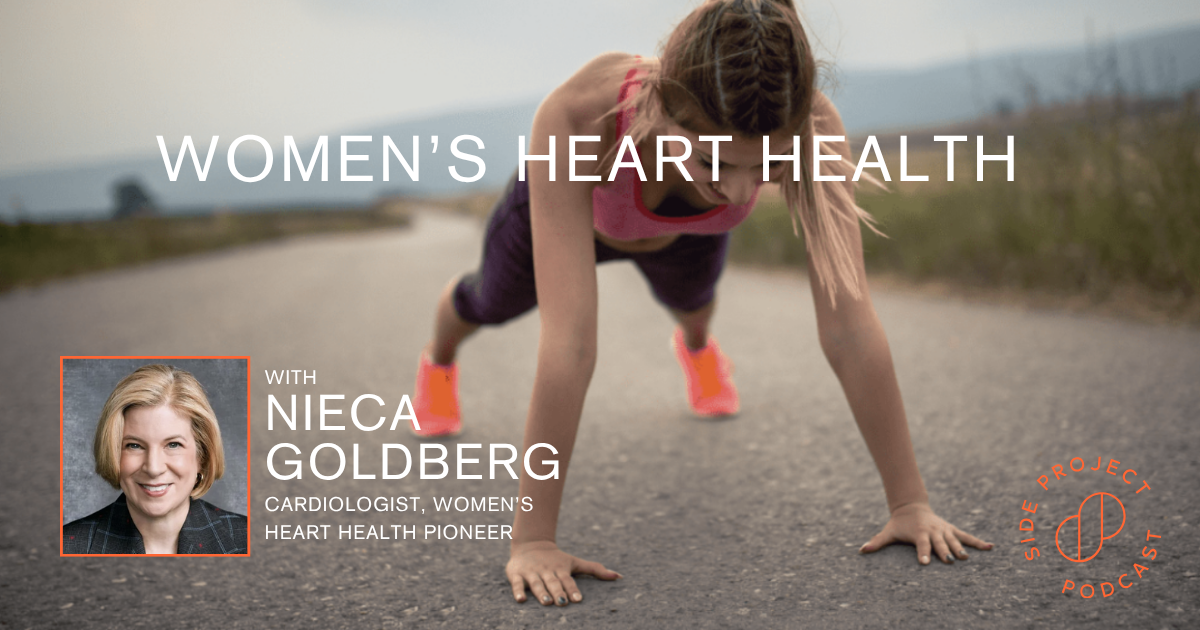
Heart disease is the #1 cause of death for women in the United States, yet an estimated 80% of heart disease cases are preventable. How can we assess our risks and change our lifestyles to keep our hearts healthy? Pioneering cardiologist Dr. Nieca Goldberg answers our questions: How does menopause affect our hearts? How much are heart issues dictated by genetics versus lifestyle? When should we see a heart specialist? We discuss everything from cholesterol and blood pressure, to heart attacks and statins, to cardio versus strength training. Dr. Goldberg signs off with her top three tips to maintain healthy hearts as we age.
Side Project Podcast 15: Women’s Heart Health with Nieca Goldberg
Leyla Seka (00:01.23)
Hello everybody, how you doing? Welcome to Side Project, our foray into all things middle age. I’m Leyla Seka and I’m here with my good friend Julie. Hi Julie.
Julie Liegl (00:11.64)
Hi, I’m Julie Liegl. And always, as always, we’re here to talk about all the things that keep coming up in conversations with friends, or at least coming up in conversations with our friends. And this season, we’re really focusing on all the ways we can maximize our health now in order to stay stronger longer. So not just living longer, but staying stronger longer. And today we’re talking all about heart health. And as I told Leyla, I’m wearing my heart sweatshirt today in honor of the topic.
Leyla Seka (00:38.326)
Always on point, you are, Julie. Heart health is really important and something that I don’t think any of us have spent enough time thinking about. As I turned 52, two of my good friends had heart attacks. They’re really healthy people. They were doing stuff. And 50% of my friends are on some kind of lowering their blood pressure medication. So this is men and women, but I was shocked when I turned 50 how prevalent this seemed to be across so many of the people I interact with. I know that, know, Julie, we’ve seen the statistics, we’ve looked into this. It really is the number one cause of death for women, I think in the United States.
Julie Liegl (01:17.134)
And obviously it’s great that we’ve done such a good job of raising awareness of breast cancer. That’s huge. It’s important. Get your mammograms, screen all the time. But that heart disease really is the number one cause of death and it kills maybe one in five, others say one in three women a year. I mean, that’s huge. So we need to really focus on that the same way we focused on these other aspects.
Leyla Seka (01:37.732)
Totally, so I mean, and that is a very exciting reason why we got this guest on who Julie is gonna introduce in just a second, but talk about someone who’s certainly pioneered the notion that women need to pay attention to their heart health the same way that men have been told to and with their own nuance that we always have as women. But I’ll let Julie do the intro and then we’ll start talking to Dr. Goldberg who is an absolute baller.
Julie Liegl (01:58.602)
Yes, we’ll get to the heart of it. We are so lucky to have with us here today, Dr. Nieca Goldberg. Dr. Goldberg is a cardiologist and nationally recognized pioneer in women’s heart health. She’s an associate professor of medicine at the NYU School of Medicine and has written multiple books, including one called, and I absolutely love this title, Women Are Not Small Men, Life-Saving Strategies for Preventing and Healing Heart Disease in Women. I can’t wait to learn more about that title. She’s a national spokesperson for the American Heart Association and she is not messing around when it comes to women’s heart health. So I think we’re in very good hands today. Welcome Dr. Goldberg.
Nieca Goldberg (02:39.272)
Thank you, it’s great to be with both of you today.
Leyla Seka (02:42.915)
We’re so excited you’re here. I mean, and I guess like, let’s just dive in and start talking. Why, I mean, outside of the fact that they’ve basically not paid attention to women’s health with the exception of us giving birth. Now we’ll put that aside for a second. Why has women’s heart health been so ignored? And why don’t more of us realize the risk of heart issue until we’re sort of in it or our friends and family are in it?
Nieca Goldberg (03:10.162)
Well, it’s been a real challenge for women. Unfortunately, so many women learned about the risk of heart disease on the day they were having a heart attack, right? And this started a long time ago. There was a research study that was started in Framingham, Massachusetts called the Framingham Heart Study that started in 1948. And what they did is they started the population of Framingham, Massachusetts, for things like high blood pressure, their other risk factors for heart disease and whether or not they were having heart attacks. And now they’re probably into the great grandchildren by now in the study. And I wanna preface what I’m gonna say by saying that they really, that study really gives us a lot of information on how we were able to advance cardiology and taking care of patients.
However, there was one little aspect of the study that when they started to look at the symptoms of heart attack in men and women, they found that more men who had chest discomfort went on to having heart attacks, but not the women. So there were two problems with that. One is they looked at men that were in their 40s and 50s and women are more likely at the first analysis.
Men were more likely to have their heart attacks in their 40s and 50s, and women are more likely to have their first heart attacks about 10 years after menopause. So when they were able over time to look at the data, they later found out that women did have heart attacks, just later. However, when they initially, in medicine, things are slow to change. I work in a very conservative profession and things are really slow to change. And so when the initial analysis came out, they said, so women don’t have heart attacks. That was the analysis. Wrong! So we’ve been kind of playing catch up. That was like around the 1970s that that could come out. So we fast forward to now and certainly when my book was initially published, Women Are Not Small Men, that was a little more than 20 years ago. And we were saying the same thing. Why are women having heart attacks? And we’re still saying that. So there’s obviously a problem and a real disconnect on one, in clinical practice, how women are screened for heart disease risk factors and two, there’s so much public information out that maybe the way we’re presenting it isn’t getting through.
Julie Liegl (06:15.5)
Yeah.
Nieca Goldberg (06:17.63)
And, you know, just like in your intro, you were talking about your friends now having heart attacks, and I know the focus of your podcast is really to talk about these health issues that women are now thinking about. So now 20 years later, a new group of women are going through menopause and they’re thinking about, why didn’t anyone tell me this? But that’s what women were saying 20 years ago. So we have a problem here.
Julie Liegl (06:48.11)
Honestly, the name of this podcast could be, Why didn’t anybody tell us any of this? I feel like this is all just uncovering things we did not know was gonna happen to us as women as we got old. Nobody told us.
Nieca Goldberg (07:01.03)
Right, and so, women always have to figure it out and do it ourselves and get to the bottom of things and actually fix everyone else’s problems.
Julie Liegl (07:13.057)
Yeah. Dr. Goldberg, one thing you mentioned was women have different symptoms, and I’ve always heard that, and that’s another, know, there’s the awareness issue, and there’s also when it’s actually happening. I’ve also wondered if, as women, we kind of tend to suck it up and ignore our symptoms, but just so we all get it out here as early as possible, what symptoms should women be looking for, be aware, could be an indication of a heart attack?
Nieca Goldberg (07:38.844)
So what I want to start off by saying is having tightness or pressure in your chest that radiates to the arm, neck or jaw is a common heart attack symptom in both men and women. So everyone should know that because it’s not only about yourself, but you might be with a loved one who’s having a heart attack and you know to get them to call 911 and get them to a hospital. However, women are more likely if they don’t have that symptom to report they have a tiredness in their chest or shortness of breath. Shortness of breath where it feels like you’ve run a marathon but haven’t moved. And oftentimes women were saying that they didn’t have the tightness on the left side of their chest. Just because your heart is there, it was in the center, somewhere a little right.
So I wanna say the location isn’t always specific. If it’s above your waist and you’re feeling really bad and sick, it could be a heart attack. Go to the hospital. I’ve had patients also report to me that the tightness or pressure was in their upper back, not their chest. And you know, a presenting symptom of someone having their first heart attack could be that they just suddenly fainted.
Leyla Seka (08:47.139)
Better safe than sorry.
Nieca Goldberg (09:03.964)
You know, if somebody collapses and it’s not clear why they fainted, not all forms of fainting are a heart attack, but if they collapse, then you really need to get checked out. And to your point, Julie, women do say, sometimes do suck it up.
Leyla Seka (09:25.113)
So when it comes to heart attacks, so that’s very useful and I didn’t even know it could hurt in your back. You always see someone grip their chest like Sanford and Son and you’re like, you know, mean, that’s what I, probably half our podcast has no idea what I’m talking about. You know, like Sanford and Son, that’s what I always see in my mind. okay, so when we’re talking about this, like what,
Nieca Goldberg (09:36.06)
A Hollywood heart attack, yes.
Julie Liegl (09:38.69)
Hollywood heart attack, I love that.
Leyla Seka (09:49.146)
When it comes to this heart disease and heart attacks, like how much of this is genetics versus lifestyle? And I know this question is hard to answer, but like how do we process thinking through doing this better, whatever it is?
Nieca Goldberg (10:02.43)
Well, the American Heart Association had some statistics on this. And they felt that 80 % of heart attacks are preventable because they’re conferred through risk factors. But part of it is genetic. And I want to add, it’s not just about having high blood pressure, high cholesterol, diabetes, smoking cigarettes, being a couch potato. It’s also, or obesity, there are some other risks that we have specific for women, in women, that have to be considered when a woman has a heart attack. And that’s, does she have autoimmune disease? Like lupus, rheumatoid arthritis. Inflammation is a big stimulant, chronic inflammation is a big stimulant to the buildup of plaque the cholesterol in the walls of your artery, the building blocks of a heart attack. In addition to autoimmune disease, if you were pregnant and you had preeclampsia or high blood pressure during pregnancy or gestational diabetes, those actually increase your risk for heart disease in midlife and beyond.
So what happens in pre-eclampsia where women get hypertensive sometimes during their last trimester of pregnancy and they’re diagnosed with it, it’s really important for them to be followed because some of them get better, but over time their blood pressure goes up and they become hypertensive. So what happens is after women have their babies for the time of their pregnancy, they’re very connected in the healthcare system.
Then they have their baby and they’re taking care of their baby and bring their baby to the pediatrician and they don’t take care of themselves. Diabetes of pregnancy or gestational diabetes increases risk for type two diabetes. type two diabetes is a very strong risk factor for heart disease. It can basically increase a woman’s risk for heart disease nearly fivefold. So it’s really important to not, once you have the baby is to get established, stay in touch with the healthcare system. Find a primary care doctor and so they can check your risk factors and take your blood pressure. And if you know you have lupus or rheumatoid arthritis and you’re listening to this podcast and you haven’t thought about your heart, then you should talk to your doctor and ask what steps you need to take to learn about your risk for heart disease.
Julie Liegl (12:59.954)
I mean, I think that’s a great point and it really hit me about the whole like, you’re so connected to the healthcare system when you’re pregnant. And then it’s sort of like, boop, and now you get to take your baby to the pediatrician every six months and every year for the rest of their lives. And I’m just wondering at sort of a macro level, whether we have these respectors or not, when a woman, especially a woman who’s peri or postmenopausal is going to the doctor, what questions should we be asking to make sure we are getting our heart health or our heart risk, heart disease risk assessed? Like what things should we be on top of?
Nieca Goldberg (13:32.23)
I think it’s the perfect time to get screened for heart disease risk factors and getting blood work that will check your cholesterol profile, your glucose to see if you have diabetes and to talk to you about your family history. So family history is a really important component of your heart health. And if you had a family member like your dad had a heart attack in his 40s and 50s, or your mom had a heart attack in her 60s, that puts you at increased risk for a heart attack and may increase your risk by 30 to 35%.
Leyla Seka (14:18.969)
They’re high numbers. I mean, these risk increases are not like, it’s not 1%. These are like five times as exponential. That’s a lot of increased risk.
Nieca Goldberg (14:20.914)
These are high numbers.
Nieca Goldberg (14:29.316)
So, and actually, when perimenopausal women and menopausal women come in to see me and they’re considering hormone therapy and should they have a risk for heart disease, I’m very aggressive at learning about their risk markers. You know, there’s been a whole resurgence in prescription of hormone therapy. And as a woman, I know menopausal symptoms can be somewhat disruptive to your life and it’s real and you sleep and everything else and your mood. And it’s really important to take care of those symptoms. With that said, you need to have somebody really look at you and assess your risk for heart disease. For instance, women who had their heart attacks when they were 50 or 49 and now going through menopause. If you’ve had a heart attack, you can’t go on hormone replacement therapy, oral therapy or patches, because that’s one group of people that would be put at increased risk for having recurrent heart attack.
Julie Liegl (15:40.62)
Really?
Nieca Goldberg (15:42.588)
Yeah, so it’s not a one size fits all policy. It’s not like they took our hormones, our hormone therapy away and now you’re getting it back. You have to understand if you’re a good candidate. It’s it’s medicine like anything else. If you’re allergic to penicillin, you wouldn’t take it, right? Okay.
Leyla Seka (15:58.33)
That’s really helpful. And I think a lot of the people we’ve talked to, you we talked about hormone replacement therapy a ton and like on this podcast and everyone’s been pretty gung ho. I’m on it. Julie’s on it. Like we’re all doing it, but it’s very good to hear you saying like, whoa, whoa, there’s always things to consider and each individual person has their own stuff.
Nieca Goldberg (16:21.086)
So why not make sure it’s like the best thing for you by getting extra screening? For instance, if you have a family history, I draw blood tests for our family related markers, like something called the lipoprotein A, which is an inherited risk marker that’s a cholesterol protein that increases risk for heart attack and stroke. So you would check that out to consider if you had an early family history of heart disease, to ask your doctor if you’re a candidate to get a CAT scan to see if you have plaque in your arteries.
Leyla Seka (17:02.457)
On the cholesterol front, because my sister has been on cholesterol medication since she was 25. Both my parents had, they’re all on the same thing, always have, I didn’t have it, luckily, knock on wood. But the cholesterol seems to be everywhere again, everyone’s talking about it, people are taking medication, other people are going vegan, at least everyone I know is in this mode. What’s the deal? Obviously it affects your heart health a lot. Like, can you give us sort of the cliff notes on what’s going on with cholesterol and heart health?
Nieca Goldberg (17:37.278)
Having high cholesterol, particularly elevated LDL cholesterol, low HDL cholesterol or high triglycerides increase your risk for heart attack. It’s not the only risk factor. I, Layla, I think it’s what you just brought up is very important. Sounds like you have a family history of high cholesterol and that not all family members necessarily are affected because you’ve had your cholesterol check, but your sister’s been on cholesterol learning medicine since she was young, and that’s a condition known as familial hypercholesterolemia where it’s genetic. You’re genetically engineered to make more cholesterol. And in that case, we’re looking at levels of LDL or bad cholesterol, like 180, 200. And that’s why we put people on cholesterol medicine. So in a person, who has high cholesterol where the LDL is like 100 or not, 190 or more. And even if it’s their only risk factor, the recommendation is to go on medicine. Not everyone has to be on cholesterol medicine. There are people who have normal cholesterol and we just tell them diet and exercise. Yet there are people who have heart attacks that have normal cholesterol. So we have to find out what puts them at risk.
It’s their family history. Do they have high blood pressure, diabetes, autoimmune disease, or a condition that increases their risk for making blood clots? So it’s really important that everyone get aggressively evaluated when there’s no clear-cut obvious risk factor.
Julie Liegl (19:28.6)
See, it’s so interesting because I’ve asked now twice in doctor’s appointments, should I be on statins? I have a family history of high cholesterol. I have high cholesterol. We also have the high good cholesterol. That’s the benefit. But it’s so interesting because I’m watching my husband who’s basically the same age as I am and he is on statins and he’s had one of these scans to check for plaque. And I say it and they’re like, well, yeah, it’s a little high, but the rest of your risk factors looked okay. Let’s not put you on a statin. Shouldn’t everyone with high cholesterol be, I mean, is there a downside to going on a statin? So I’m seeking free medical advice at this point.
Nieca Goldberg (20:01.682)
Listen, it’s a medication, all have side effects and you can’t really predict it until the person goes on the medication. And some of the common side effects of statins are muscle aches, elevation of liver tests, which can be easily followed on medicine and things can be adjusted based on your, if you have elevated liver function tests. We also have non-statins that lower cholesterol for people who can’t tolerate statins. So we have a lot of options here to lower cholesterol in addition to diet and exercise. And it’s really about a Mediterranean style diet.
Leyla Seka (20:40.057)
So drink a lot of wine.
Julie Liegl (20:44.622)
Chianti?
Nieca Goldberg (21:00.722)
No! We’ll get to that later. But I wanna point out that if the cholesterol, if the CAT scan has cholesterol plaque in the arteries, if the score is, how much higher it is than zero, then people do go on cholesterol medicine. And also we tend to put people on cholesterol medicine who have elevated lipoprotein A’s, even if the LDL cholesterol doesn’t seem so high. And that’s probably until the medicines that lower lipoprotein A are released.
Julie Liegl (21:24.642)
Just really quickly, lipoprotein A, is that something I’m getting in my standard cholesterol screen, which has all these, so I should ask for that? Okay, lipoprotein A, let’s put that in the show notes, lipoprotein A.
Nieca Goldberg (21:29.564)
No, that’s an extra test. Yes, you should ask for that.
Leyla Seka (21:41.818)
So you’ve gone through a lot of signs that sort of give us an alert as to when we should see a heart specialist. But is it just to get a baseline? Is there anything else like, you know, I’m feeling breathless, I’m feeling dizzy. Is that heart specialist or GP and then what?
Nieca Goldberg (22:02.462)
Well, if you’re having shortness of breath and you’re a doctor, you see your primary care doctor and they’ve done some lab tests and an electric cardiogram. Don’t find anything, you still have the symptoms. So I think it could be beneficial to see a cardiologist. Other times that you should see a cardiologist is if your primary care doctor is treating your blood pressure and it’s just not coming down, that’s the time to see a specialist.
Leyla Seka (22:28.237)
And most blood pressure treatment is through medication, right? I mean, through like pills.
Nieca Goldberg (22:33.534)
Well, blood pressure treatment is a diet that’s low in salt, a very popular diet, which is itself a Mediterranean style diet to lower blood pressure is called the DASH diet, D-A-S-H. It stands for Dietary Approaches to Stop Hypertension. And it was sponsored by a large NIH grant and it was done about 15, 20 years ago.
And initially when they did the study, they only included at least five fruits and vegetables servings a day, low fat dairy products, lean proteins. And there were small changes in the blood pressure. When they redid it and lowered the salt content, they got even better blood pressure.
Julie Liegl (23:27.502)
I have low blood pressure though, so I can eat all the salt I want, right? If I have low blood pressure, I should just be drowning in salt.
Nieca Goldberg (23:31.388)
That’s right. And we’ll get to that. Yeah, I’m going to get to that because that’s not as bad as having high blood pressure.
Leyla Seka (23:39.539)
I have that too. Let’s just live well for as long as we can.
Julie Liegl (23:39.714)
Right, I’m gonna live forever.
Nieca Goldberg (23:47.401)
Also, Leyla, I want to also say… Julie said something about having good levels of, high levels of good cholesterol. And I want to point out that we’re learning more about good cholesterol. We didn’t know, we don’t know how much it really lowers your risk. Because in people who have HDL, which is the good cholesterol, and we were always saying we want that to be high, like H for high and then LDL, L for lousy. Those are cute little terms we use in practice.
Julie Liegl (24:20.792)
Or lethal.
Nieca Goldberg (23:47.401)
Yeah, or no, you don’t want to say lethal in a patient visit. That’s not a good thing. Not a good thing.
Leyla Seka (24:27.893)
I don’t think that, not for saying lethal, does not work for anybody ever. No one wants to hear that ever.
Nieca Goldberg (24:54.91)
So anyway, they’re finding that particularly in HDL cholesterol that are above 80, they may not be as protective because the HDL is not as functional in prevention.
Julie Liegl (24:50.946)
So even my good cholesterol is bad.
Nieca Goldberg (24:54.91)
I wouldn’t call it bad. I would call, it’s, it’s there. It’s better than have HDL a 30.
Julie Liegl (25:01.386)
It’s not as useful as I’ve been led to believe. Okay.
Leyla Seka (25:06.401)
So then onto the blood pressure things, I do actually have low blood pressure too, like I have to drink these gross salt drinks all the time or I get super dizzy and weird. What’s the deal with low blood pressure? Why do we have low blood pressure? We have high-pressure, really stressful jobs. We should have really high blood pressure, I feel like.
Nieca Goldberg (25:19.048)
Well, not everyone responds to stressful jobs in the same way. I also have low blood pressure. So it’s really important when you have low blood pressure to hydrate, and you don’t have to eat a salt restricted diet. And if you’re the kind of person who feels lightheaded when you go out, think it’s important not only to carry water, but a salty snack. So you can give yourself a boost of salt.
Leyla Seka (25:51.833)
Okay, yeah, that’s basically what I’m doing.
Julie Liegl (25:55.522)
I was going to say, does blood pressure though change as we age? Is that different for women or for men? Like is it, I’ve always had this low blood pressure, but now that I’m getting up there, is it going to start going haywire? Like everything else in my body.
Nieca Goldberg (26:06.974)
Well, depends on the person and blood pressure can go up as you go through menopause because the blood vessels become less flexible. However, there are ways that we can ensure that our blood vessels are flexible by regular exercises, a very good stimulus to keep our blood vessels flexible.
Leyla Seka (26:36.505)
Good, good. And how regular do you think people should exercise? Don’t ask Julie. You’re anexercise freak. You exercise constantly.
Julie Liegl (26:37.944)
Just gonna go to exercise. think we’ve talked about on several episodes of this podcast is like cardio versus strength training. And even within cardio, this is turning into a 12-part question. I’m hearing about zone two training versus, you know, maxing out. Like what’s the right mix if we’re trying to think of heart health specifically in terms of how we should be exercising?
Nieca Goldberg (27:06.654)
Well in heart health, it’s good to have a combination of both aerobic exercise and strength training. And I recommend doing aerobic activities that you like so you’ll stick with them. Because if you decide to take something that’s your friend’s favorite exercise, like they want to go dancing, but you’d rather ride a bicycle, then you’re not going to do that too often. So it’s really important to pick an activity that you like.
When I get into the zones, know there’s a lot of zone two exercise. So zone two exercise is equivalent to taking a walk. And what zone two exercise does is it builds up endurance to stay in the exercise. When you talk about the upper zones, which is more in HIIT exercise and high intensity interval training, to kind of simplify exercise physiologist, exercise physiology is that when you exercise aerobically, you initially burn fat as fuel. And as you increase exercise, it switches over to using carbohydrates as a fuel source. And that’s when you start to get anaerobic and you start to feel the fatigue. So zone two exercise is great. It builds endurance. It actually is believed to stimulate growth of mitochondria, which are the fat components of cells.
So I think that’s all good, but it’s also important to build endurance, particularly when you get into higher levels of exercise. So it’s important to actually do zone two exercise and then sometimes get into the zones three and four. Elite athletes get up there. For the person who really wants to be healthy and fit to prevent heart disease, it’s really a combination that’s mostly zone two exercise with higher intensity zones and strength training.
Julie Liegl (29:38.604)
And then where do you put the lifting? How does the strength training fit into that?
Nieca Goldberg (29:43.069)
And the strength training is important because strength training actually helps strengthen the muscles that you’re gonna do in aerobic activity. So you’ll become more efficient when you’re doing your aerobic activity. But it also like with aerobic activity decreases your percentage of body fat.
Julie Liegl (30:05.548)
Yeah. Where are you on weighted vests? Are you wearing a weighted vest? Should every woman in the world be wearing weighted vest?
Nieca Goldberg (30:10.63)
No, I’m not like one to do trends. I think weighted vests are a personal thing. I think initially they started out to improve people’s posture, right? I don’t know if you know this, but as a cardiologist, I had to wear the ultimate weighted vest when I was training. Because we had to do procedures that involved radiation and you wear these big lead aprons. And I don’t want to revisit that.
Julie Liegl (30:46.062)
It’s a little PTSD for you.
Nieca Goldberg (30:48.664)
Yeah.
Leyla Seka (30:50.169)
Well, that kind of makes sense. I wear it and I will say it has helped my posture when I’m walking, right? Like my shoulders go back more. I don’t hunch as much as I do when I’m not wearing it, but it is definitely, you’re either in the club or you’re not. Similar with Pilates, you’re either in or you’re not in is the way it seems to be going with that one.
Nieca Goldberg (31:08.19)
Well, I’m doing something different now. I’m doing gyrotonic training, which is, well, it’s similar to Pilates in that it involves core strength, posture, balance, and it was started by a ballet dancer. And it helps ballet dancers rehab from their injuries.
Leyla Seka (31:34.745)
interesting.
Nieca Goldberg (31:35.356)
Just like Joseph Pilates did it for soldiers. And I started it, unfortunately, after I fractured my ankle because I very unglamorously tripped in a pothole on Madison Avenue.
Leyla Seka (31:56.163)
Those streets are hardcore, man. Yikes.
Nieca Goldberg (31:59.615)
And I was wearing sneakers and this nice man said, can I help you up? I said, yes. And I hobbled home. And then we had an X-ray and I saw a foot specialist and I was in a boot for a while. But I’m lucky I didn’t need surgery. So this has really helped me and helped my posture and balance. Like after I take the class, I think it’s, I feel so much taller.
Leyla Seka (32:26.713)
I love those classes when that happens. Like I feel like I grow a little after yoga sometimes. I’m like, it’s unbelievable. Definitely taller right now. I try not to pay attention to that at all.
Nieca Goldberg (32:32.53)
Right, exactly.
Julie Liegl (32:34.666)
At an age where we’re shrinking. It’s nice to get any extra length. Dr. Goldberg, I hate to go back to something that I think is gonna be out of a bummer, but Leyla and I did make the joke about drinking wine on the Mediterranean diet, and you said, we’ll get to that. And I feel like this comes up in almost anytime we talk to anybody with any medical background, but this is the part where you tell us that we can’t have wine anymore.
Nieca Goldberg (32:58.556)
No, I don’t exactly say that. I just tell you the truth. It doesn’t prevent heart disease.
Leyla Seka (33:03.609)
Tell us the truth, tell us the truth. That’s what we want.
Julie Liegl (33:10.158)
Is it also a risk factor, I guess is where I’m going. Like how dangerous is that?
Nieca Goldberg (33:13.832)
Well, it depends how much you drink. Okay, so everyone’s concerned about their weight, right? And every woman who’s going through perimenopause and menopause looks at their belly and says, how do I get rid of this? Because they say that to me in the office. So I, you know, this is common. And first of all, alcohol is sugar. I just want to remember, remind everyone it’s sugar.
Leyla Seka (33:21.357)
Yeah.
Nieca Goldberg (33:42.78)
So it goes to all the same place that the other sugar goes to.
Julie Liegl (33:48.195)
Right.
Leyla Seka (33:50.585)
What about smoking pot? Give us something, Dr. Goldberg. Come on, midlife is rough.
Nieca Goldberg (33:57.311)
Well, I know, but you know, smoking pot, you know, there are cardiac concerns in it. They’re just being elucidated. And you know, it’s about how you tolerate these things. And it’s all about doing life in moderation.
Leyla Seka (34:22.403)
Right. But moderation doesn’t get you buzzed, Dr. Goldberg.
Julie Liegl (34:25.858)
Hey, Leyla, I think you got a maybe, and I honestly think that’s as well as we’re gonna do on the pot question.
Leyla Seka (34:31.673)
I should take it. I should take it.
Julie Liegl (34:36.874)
Right. And maybe just no pot brownies going back to the sugar problem.
Nieca Goldberg (34:46.012)
No brownies.
Julie Liegl (35:06.08)
All right, Dr. Goldberg, we started throwing out vices at you. Let’s grab this up on a positive note. What are like three tips you have? Just, you know, let’s hit him where it hurts or hit him where it helps. Like what are three tips you have for, let’s be honest, the mainly women who are listening to this who are at the perimenopause menopause age that we should be thinking about for our heart health. What are the top three things we can do?
Nieca Goldberg (35:12.734)
I think you can exercise. I think it is one of the top things to do for heart health. The second thing is that you should go get your heart risk checked out.
Leyla Seka (35:27.225)
And you just ask your GP, right? You say, I want to get all my heart risk factors sorted out.
Nieca Goldberg (35:30.3)
Right, heart risk checked out. And if they feel that you have a family history of heart disease or family history of high cholesterol and think they need a little help in terms of your screening, then you should see a cardiologist.
Julie Liegl (35:47.01)
That’s great.
Leyla Seka (35:47.235)
Get it checked is basically what you’re saying. Yeah, and even if you don’t have any of those risks, get it checked, why not?
Nieca Goldberg (35:48.968)
Get it checked out.
And the third thing is to keep stress in check. And that means if you’re stressed, have anxiety, depression, if you can’t figure it out yourself, get therapy, cognitive behavioral therapy. That’s really helpful. Exercise also helps improve mood.
Leyla Seka (36:21.561)
Very true.
Julie Liegl (36:22.434)
That’s such a great point. And we’ve done episodes on mental health and it is a reminder, like we do all these episodes, but everything is so interconnected, maybe even more so at this stage of life. So I think that’s a really good tip. we didn’t even ask about mental health, but that’s such a great point that that’s obviously a risk factor and obviously something we can proactively work on.
Nieca Goldberg (36:32.072)
That’s right.
Leyla Seka (36:46.361)
100%. You’re amazing, Dr. Goldberg. Everything you told us was so helpful. And we didn’t even talk about your book, which is crazy because your book was amazing. And the title of your book is amazing. Women Are Not Small Men, which I think is pretty much how our healthcare has been assessed through most of modern history, which is hard to get. Yeah, little men, we are not little men, we make people. We do something much different than they do in that.
Nieca Goldberg (37:33.426)
That’s right. In the model of men. And the publisher retitled the book when I wrote my second book, The Complete Guide to Women’s Health. They said, we’ll also have you update your book and we’d like to change the title.
Leyla Seka (37:56.758)
To what? Why? I love the title.
Nieca Goldberg (37:58.631)
to the Women’s Healthy Heart Program. Well, you know, that’s publishing. And I was really, when they called me in the office, I was seeing patients and I, you know, I didn’t have time to ask questions and, you know, because I was busy.
Leyla Seka (38:11.097)
You were saving lives. Of course.
Julie Liegl (38:14.442)
And trying to figure out why we’ve only ever been studied is just slightly smaller versions of men as opposed to different creatures with many different systems and things going on in our bodies. So thank you for writing these books.
Nieca Goldberg (38:22.163)
Yeah.
Leyla Seka (38:27.129)
Well, we’re deeply thankful for you, Dr. Goldberg, for pioneering, getting in there and making noise about how we have to pay attention to our hearts and our health and, you know, fight for tests with the doctors, which it’s ridiculous that we have to do that, but we do and do all the things we have to do to keep ourselves as healthy as we can for as long as we can. So I know we’re coming up on time, Jules, we are, aren’t we? But I’m so grateful. You were amazing. And I know all our listeners are fired up.
Julie Liegl (38:58.368)
Huge thanks to Dr. Nieca Goldberg for joining us. You can find a recap of all this information, including the names of these books and the names of these proteins we should be screening for at our website, which is sideprojecthq.com. Thanks so much for joining and we will see you next time.
